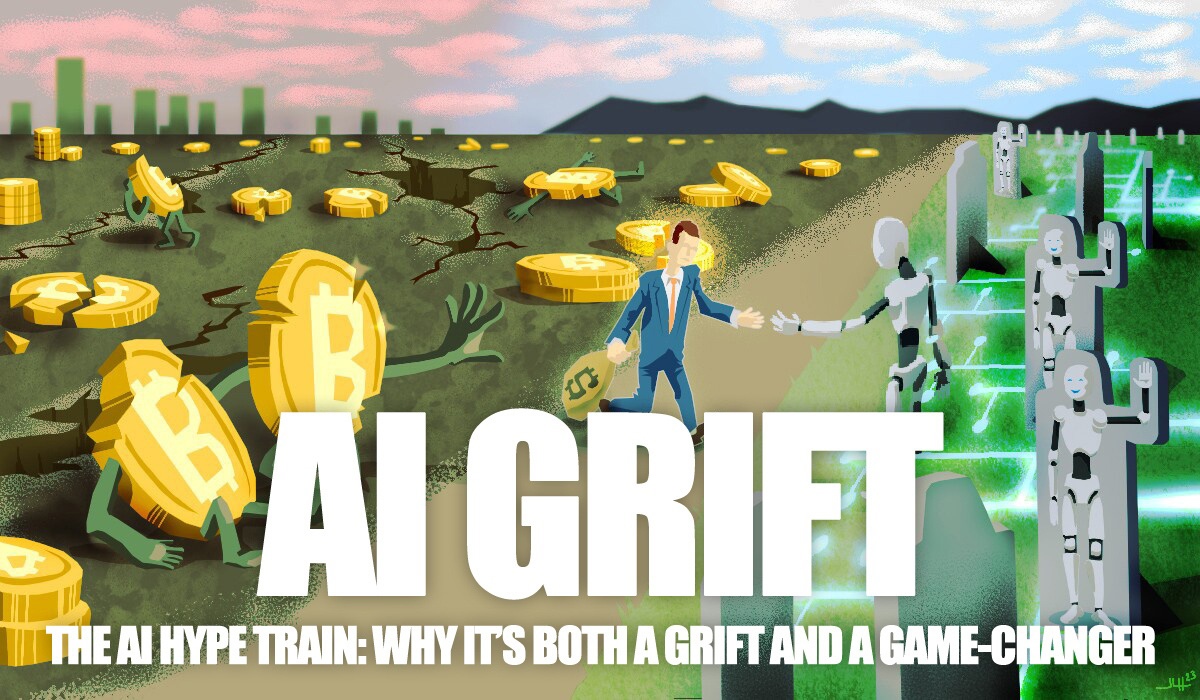
Artificial Intelligence has become the latest buzzword in tech – much like blockchain, crypto, NFTs, the metaverse, big data, VR, and IoT before it. Each of these technologies followed a familiar arc: genuine capability gets discovered, marketing gets ahead of reality, investment floods in, expectations overshoot, and the inevitable correction follows. Some technologies survive that correction and become foundational. Others don’t.
AI is somewhere in the middle of that arc right now. That doesn’t make it useless – it makes it overhyped. Those are different problems, and conflating them is how businesses end up either dismissing a useful tool entirely or throwing money at it with no strategy. This article is an attempt to be honest about both sides.
The Buzzword Problem
The pattern is consistent across tech cycles. A technology with real but limited utility gets marketed as a solution to everything, attracts enormous capital, disappoints at scale when the limitations become apparent, and eventually settles into whatever its actual use case turns out to be. Blockchain was going to revolutionize banking, healthcare, supply chains, and voting. The metaverse was going to replace the internet. Both have real applications – neither delivered on the headline promises.
AI is experiencing the same phenomenon. The term is being applied to products and services the way “blockchain-powered” was a few years ago – mostly to signal relevance and attract investment. Most of what gets called AI today is advanced machine learning, specifically large language models (LLMs) like GPT-4, which are very good at language tasks and genuinely poor at most everything else. They are not general-purpose problem solvers. They don’t reason. They predict the next word in a sequence with extraordinary sophistication – and that turns out to be useful for a specific and well-defined class of tasks.
The gap between what AI is marketed as and what it actually does is where the grift lives. And the data is starting to back that up.
The Trough Is Real – And We’re In It
Gartner’s Hype Cycle for Artificial Intelligence placed Generative AI in the “Trough of Disillusionment” in 2024 – the phase where early excitement gives way to implementation reality. The numbers tell the story: organizations averaged $1.9 million spent on GenAI initiatives in 2024, yet less than 30% of CEOs reported being satisfied with the return on that investment.
This isn’t a fringe opinion. It’s the natural consequence of deploying a technology before understanding what it’s actually good at. Low-maturity organizations struggled to identify suitable use cases. Higher-maturity organizations struggled to find skilled people and build internal literacy. Both groups found that the tool didn’t perform the way the marketing said it would – because the marketing was selling a vision, not a product.
That said, Gartner’s framework also identifies what comes after the trough: the Slope of Enlightenment, where organizations refine their understanding and find the use cases that actually work. That’s the phase worth preparing for.
What AI Is Actually Good For
LLMs are genuinely useful when applied to the right problems. Drafting content, summarizing documents, translating languages, generating boilerplate code, organizing ideas – these are real productivity gains, and the businesses getting value from AI are the ones using it for exactly these kinds of tasks.
The key word is assisting, not replacing. AI should be viewed as a tool in a larger toolbox – one that complements human expertise in areas where it excels and falls short everywhere else. Just as you wouldn’t use a hammer for every task, you shouldn’t rely on an LLM for decisions that require judgment, context, or genuine understanding of your business.
The businesses getting real value from AI are the ones using it deliberately – not the ones that bolted it onto their product description to sound current. If you want a more tactical breakdown of where LLMs actually fit into website and marketing work, we covered that here.
The Science Behind the Skepticism
Consumer behavior research is catching up to what many people already sense intuitively. A peer-reviewed study published in the Journal of Hospitality Marketing & Management surveyed over 1,000 U.S. adults and found that including the term “Artificial Intelligence” in product and service descriptions actually decreases purchase intention. Emotional trust mediates this relationship – consumers feel less confident, not more, when AI is explicitly called out.
The effect was stronger for higher-risk purchases than lower-risk ones. In other words, the more important the decision, the more the AI label works against the product.
This is the irony buried inside the AI marketing push: the term being used to attract buyers is, in many cases, actively pushing them away. That’s not an argument against AI. It’s an argument against lazy marketing – which is most of what the current hype cycle actually is.
The Longer View
The tech industry has been here before. Over-promising and under-delivering leads to skepticism, correction, and consolidation. What survives is the actual utility – the workflows where AI assistance saves real time, the tools built on LLMs that solve specific problems well, and the professionals who learned to use it as a force multiplier rather than a replacement for expertise.
AI isn’t going away. But the version of it being sold to you right now – as a universal solution, a silver bullet, a paradigm shift that changes everything overnight – is the grift. The useful version is quieter, more specific, and a lot less exciting to put in a press release.
Need Help?
If you’re trying to figure out where AI tools actually fit into your website or marketing – or whether a vendor’s “AI-powered” pitch is worth anything – reach out anytime.
Research
A peer-reviewed study of over 1,000 U.S. adults found that including the term “Artificial Intelligence” in product and service descriptions decreases purchase intention, with emotional trust mediating the effect. The impact was stronger for high-risk products than low-risk ones – suggesting that AI labeling can actively undermine consumer confidence rather than build it. Separately, Gartner’s 2024 Hype Cycle confirmed GenAI has entered the Trough of Disillusionment, with organizations averaging $1.9M in AI spend but fewer than 30% of CEOs satisfied with the return.
Source: Journal of Hospitality Marketing & Management – AI Disclosure and Purchase Intention (2024)