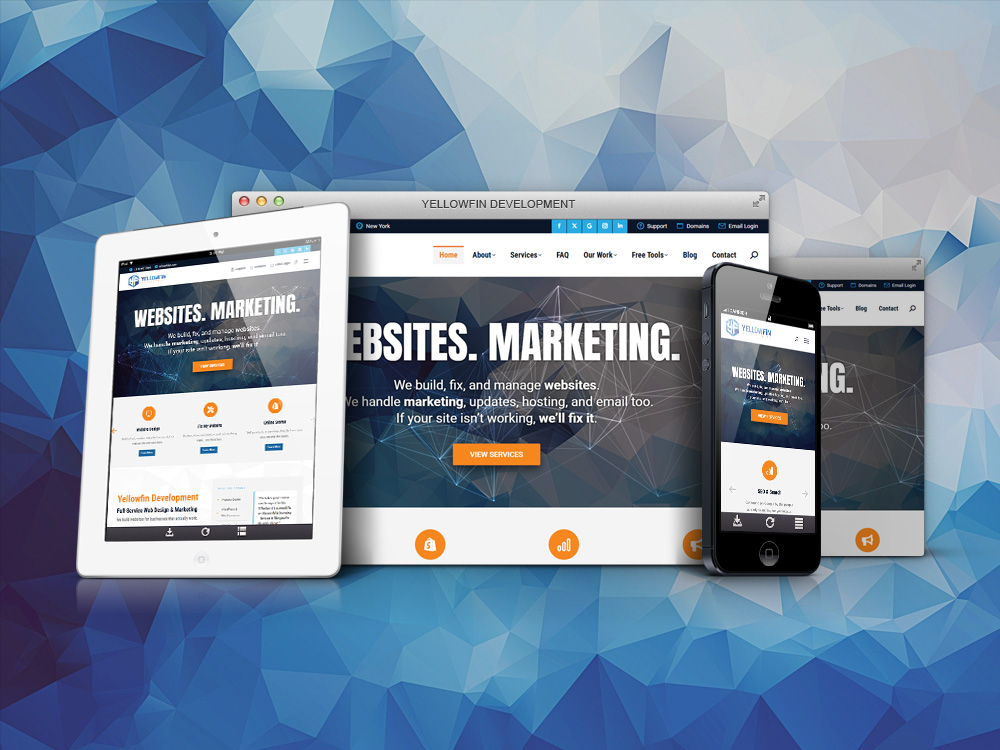
You know the old saying – “the cobbler’s kids have no shoes.” For a while there, that was me. I spend my days building, fixing, and managing websites for other people, somewhere in there my own site fell off the priority list. It happens. The work that pays comes first, and the work for yourself waits for a quiet week that never arrives.
Eventually I looked at yfdev.com and realized I was overdue for the exact thing I tell clients not to put off. So, I rebuilt it.
And the more interesting story isn’t what I added – it’s what I deliberately left out.
First, What I Didn’t Do
I wasn’t interested in chasing trends or awards. No giant 160px hero text. No flashy parallax image that takes four seconds to load and shifts the whole layout while it does. No obfuscated pricing that makes you “book a discovery call!” before anyone will tell you what something costs. And no agency buzzword nonsense about “elevating your unique brand character to the next level!” or “revolutionizing your digital journey!”. Nobody talks like this, read that out loud to someone, watch their face, that’s your conversion rate.
That language serves the agency, not the client. It fills space where actual information should be.
A lot of modern web design serves the designer more than the visitor. A giant animated hero section is a great way to show off how the designer spent more hours on CSS than on copy… It is a poor way to tell a small business owner what you do and whether you can help them. Those are not the same goal, and somewhere along the way the industry started confusing them.
So, I Brought Informational Back
The whole point of a website is to give people the information they came looking for. What do you do. What does it cost. How do you work. How do they reach you. Everything else is decoration – and decoration that gets in the way of those answers is working against you.
This isn’t a hunch. It’s what people actually want when they land on a site (with statistics that haven’t changed in over 10 years).
86%
of visitors want product or service information when they land on a site. 64% expect contact details. They came for answers, not animation.
44%
of visitors will leave a site outright if they can’t find contact information. The flashiest hero in the world can’t fix a missing phone number.
So the new site leads with information. Clear services. Real pricing where it makes sense. Straight answers. The kind of site I would want to land on if I were the one searching for help.
Now, About That Slider
Now, before anyone calls me a hypocrite – yes, I kept a big beautiful animated slider on the homepage with some particle effects. Because, I like a little flash. And a man is allowed a little vanity.
I’m not against flash. I’m against flash that gets in the way of the job. It comes down to building the right thing for the work in front of you.
You can’t expect a Pinto to perform like a Ferrari, and you can’t expect a Ferrari to perform like a pickup. Each one is built for a different job, the mistake is picking the wrong one for what you actually need to do. Most business sites need a pickup – something built to do work. But there’s nothing wrong with a nice paint job on it.
My homepage slider… is the paint job. The work still gets done. 2 simple words: Websites. Marketing. The trouble only starts when someone builds a Ferrari and then wonders why it can’t haul 2x4s to a job site…
Built on the Stack I Actually Recommend
It is built on the same stack I recommend to my clients – managed WordPress hosting, proper infrastructure, SSL, daily backups, the works. Because I should at least be running the good stuff I sell. If I’m going to tell a client that cheap hosting will cost them more in the long run, my own site had better not be sitting on a five dollar plan.
And WordPress… it’s not a trend, it’s not going anywhere.
41.9%
of all websites on the internet run on WordPress – more than every other platform combined. The CMS people keep declaring dead still runs the web.
49.2%
of the top one million sites on the web run WordPress, which puts the “it’s only for small blogs” argument to rest.
I build it on the stack that will still be here, and still be supported, when my clients need it – while the “WordPress killers” come and go.
The Launch Was the Easy Part
Here is the thing most people get wrong about a website launch. Hitting publish is not the finish line. It is the starting line.
The launch is the easy part. Now comes the actual work:
- SEO and technical auditing – making sure search engines can find and understand the site.
- Core Web Vitals and performance – the ongoing tuning that takes a site from “live” to “fast.”
- Content and structure – schema, internal linking, and answers written for real people.
- Maintenance – updates, monitoring, and security that never really stop.
None of that shows up in a launch announcement, and all of it is what decides whether the site does anything for the business behind it.
A website that was built to “be a website” and nothing more is the most common reason a site underperforms. No one cares about a website, they care about what the website can do for them – generate leads, answer questions, make the phone ring. That only happens when someone keeps working on it after launch day.
Which is kind of the whole point. A site is not a thing you finish. It’s a thing you maintain.
So Have a Look
The new yfdev.com is live, and the real work is underway. If you want to see what informational over flashy looks like in practice, go take a look. (Particle effects included because a nice paint job never hurt anyone!)
Need Help?
If your site isn’t doing anything for you, that’s usually a sign it was built to exist rather than built to perform. That’s a conversation worth having. Reach out anytime.
Whether you need help with the building, the fixing, or the managing – you know where to find me.
“A site is not a thing you finish. It’s a thing you maintain.”
Statistics & Sources
What Visitors Actually Want
86% of website visitors want product or service information, 64% expect contact details, and 52% want to learn about the company. 44% of visitors will leave a site entirely if no contact information is present – confirming that people come to a website for answers first.
WordPress Market Share
As of 2026, WordPress powers 41.9% of all websites on the internet and roughly 59.4% of every site built on a known content management system – more than all competitors combined. It runs 49.2% of the top one million sites, putting the “WordPress is only for small blogs” claim to rest.
Sources