
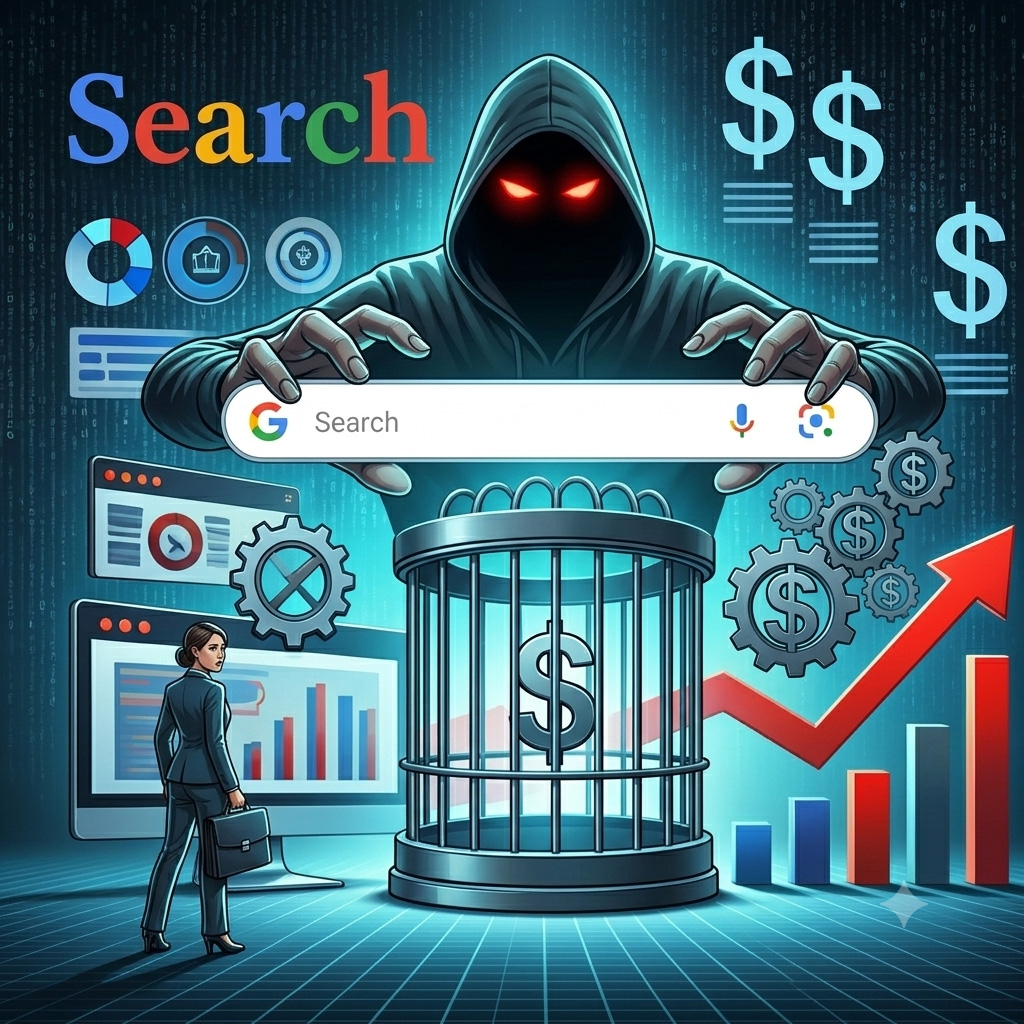
The rise of AI-powered search is changing how people find information online – and not in a way that benefits your business. Search engines are scraping content from your website, using it to generate answers directly on the results page, and keeping users from ever clicking through to your site. You lose the traffic. They keep the audience. Then they sell it back to you as advertising.
That’s the loop. And it’s worth understanding clearly.
Search Engines Are Now Your Competitors
For years, businesses relied on search engines to send traffic their way. That relationship has changed. Search engines now use your content to answer questions directly on the results page – which means users get what they need without ever visiting your site.
The detailed answers that used to require a click-through are now served inline. Your organic traffic drops. The content you created still has value – it’s just generating that value for someone else’s platform now.
And here’s where it gets worse: once they’ve siphoned off your organic visitors, they turn around and sell you advertising to replace them. They took your content, used it to enrich their platform, cut off your traffic, and are now offering to sell your audience back to you. Every cycle of this makes them more valuable and your organic presence less so.
How This Is Hitting Websites Right Now
- Reduced click-through rates: When users find answers directly on the search results page, fewer people visit your site.
- Content exploitation: Your content is being used to train AI models and populate AI Overviews without compensation or attribution.
- Pay-to-play pressure: Businesses are spending more on paid search to replace organic visibility they used to earn.
- Loss of control: Inaccurate or outdated information can appear in AI-generated results, and you have limited ability to correct it. Hallucinations.
What You Can Actually Do About It
You’re not powerless here, but the response has to be deliberate:
- Structured data markup: Implement Schema.org markup so search engines understand and display accurate information about your business. This is one of your best levers for influencing how AI Overviews represent you.
- Content that earns clicks: AI Overviews summarize – they don’t replace depth. Content with genuine insight, original analysis, or specific local knowledge still drives click-throughs because it can’t be fully replicated in a snippet.
- Search Console submission: Keep your sitemap current and your key pages properly indexed. Make sure search engines are working from accurate, up-to-date data. Spend some time in your GSC investigating what’s indexed.
- Diversify your traffic: Email lists, social presence, and direct relationships with your audience reduce your dependence on search engines entirely. If they change the rules tomorrow, you still have an audience.
- Monitor how your content is being used: Track traffic trends in Google Analytics and Search Console. If a page that used to drive traffic has dropped off, check whether it’s being summarized in AI Overviews instead (it can still be a conversion driver, not all AI summaries are bad).
The Longer View
This isn’t going away. As AI Mode becomes the default search experience, the platforms that once sent you traffic will increasingly keep it. The businesses that adapt – with better structure, more original and novel content, and less dependence on a single channel (walled-garden platforms) – will be in a stronger position than those waiting for organic traffic to recover on its own (safe to say – it likely won’t).
Need Help?
If your traffic has dropped and you’re trying to figure out what’s driving it, or you want to make sure your site is structured to hold up in AI search, reach out. That’s exactly what we work on.
Research
AI Overviews now appear in over 13% of U.S. desktop searches, up from 6.5% in January 2025. Pages cited in AI Overviews are predominantly drawn from existing top-10 organic results – meaning strong SEO still matters, but the traffic those rankings generate is increasingly being intercepted before a click occurs.



1 Comment